Overview
Emost’s Butler units are powerful, mobile battery systems that replace diesel generators on construction sites, at events and for emergency power. Managing a distributed fleet of such high-value hardware was a serious operational challenge. I designed Electrify OS, the IoT platform that acts as the digital brain for the entire Butler fleet.
It wasn’t a standalone app. It was the essential interface between people and machines, built into the system from the start: remote monitoring, intelligent energy management and access control, in a mobile-first interface made for use in the field.
- Responsibilities
Personas to prototype
User persona definition, user flow mapping, wireframing, high-fidelity UI design and prototyping.
- Product
B2B IoT platform
Fleet monitoring, single-unit control, reporting and role-based access for the Butler battery range.
The challenge: a “black box” fleet
Without a central software hub, every Butler unit would be an isolated black box. For companies running a fleet, that meant real operational risk and wasted effort. These were the pain points to solve from day one.
- Pain point
No remote visibility
Nobody could see a unit’s status, location or performance without a physical check.
- Pain point
Inaccurate usage tracking
Tracking energy use by hand for billing and reporting was slow and error-prone.
- Pain point
No proactive maintenance
A problem could go unnoticed until a unit failed on a critical job site.
- Pain point
Insecure access sharing
There was no easy way to control which employees or clients could operate specific units.
The users
The platform serves a wide range of professional users, each with different needs and permissions. Defining these roles was key to making the design powerful without clutter.
- 01AdminA high-level view of the whole fleet, detailed analytics and full control over user management.Full fleet
- 02Service partnerDeep diagnostic data and historical performance logs to troubleshoot issues remotely.Diagnostics
- 03Customer companyStatus and usage reports for the specific units they own or rent.Own units
- 04OperatorA simple, mobile-friendly interface to run a single unit on site and see its immediate status.One unit
- 05GuestTemporary, read-only access to one unit’s status.Read-only
The design
A comprehensive, role-based, mobile-first platform that gives clarity at every level.
1. The five-second fleet overview
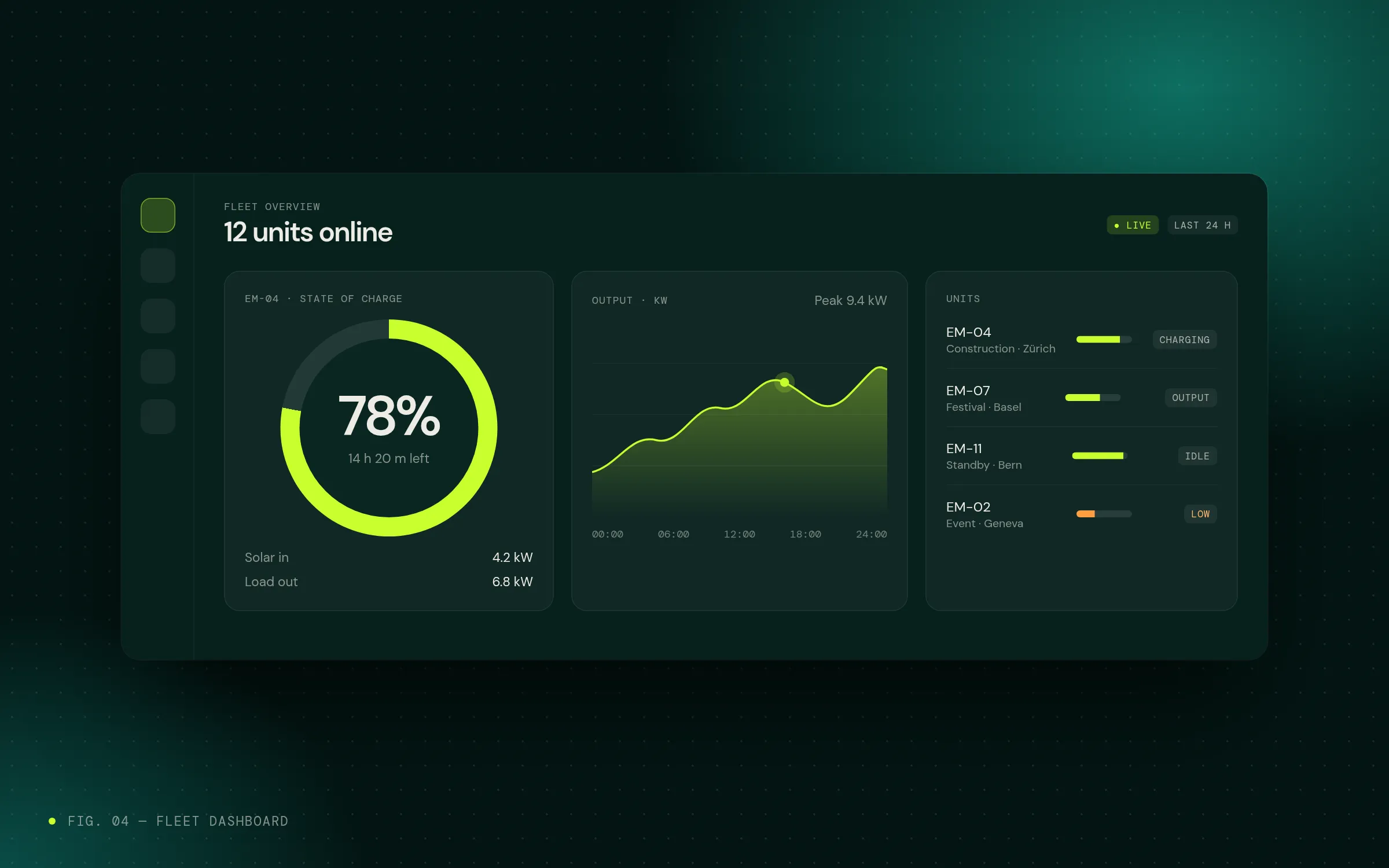
For a busy admin or service partner, situational awareness comes first. The main dashboard answers the critical questions in seconds: is everything OK, and if not, what needs attention? It combines a map for live location, a filterable list with the real-time status of every unit (online, offline, error), and a live event log of recent activity.
 Placeholder
2. Role-based simplicity
To prevent information overload and unauthorised use, the interface adapts to each role. An admin sees everything, including historical location data that helps diagnose problems linked to a unit’s working environment. An operator’s view is radically simpler: only the status and controls for their assigned unit, so they can focus on the job in front of them. That split is what makes the platform powerful for managers and easy for field staff.
3. From monitoring to management
Beyond status checks, Electrify OS turns data into decisions. The single-unit dashboard shows real-time detail, from state of charge to granular power-electronics data. Reports let admins track long-term performance, calculate CO₂ savings and export usage data for billing.
Impact
Built into the Emost ecosystem from day one, Electrify OS was fundamental to the Butler’s success. It defined the product as a fully integrated, smart energy solution rather than a standalone piece of hardware.
- −30%Unnecessary on-site service checksEstimated, thanks to remote diagnostics and proactive alerts.
- Result
More uptime
Real-time error monitoring meant faster fixes and a more reliable fleet.
- Result
Leaner operations
Automated usage reports and secure access sharing saved admin time and improved billing accuracy.
- Result
A selling point
The platform offered a level of control and transparency that diesel generators couldn’t match.